-
Outside hospital transfers: If you receive a page or call regarding an outside hospital transfer, please refer the caller to the attending on call. All transfers need to be approved by the Attending on call.
- Start H&P and problem list and place orders during activations when surgery junior is available to bedside
- Be familiar with all patients admitted to the service and with their plans for the day, so that patient care is not compromised when the chief/junior are in the OR
- Participate in bedside procedures
- If the rest of the team is in the OR, work with the Red APP to ensure that the patient care continues to progress for the remainder of the service.
- The Blue attending is the backup attending during the day, and the ICU attending is the backup at night. If a patient has a change in status (new tachycardia, arrhythmia, hypotension, hypoxia, altered mental status, hemorrhage, sepsis, etc), and the rest of the team is in the operating room, it is your responsibility to alert the backup attending immediately.
- If you have a question regarding the existing plan of care that cannot be answered by the Red APP, go to the operating room to ask for help.
**
Red APP: **
An APP is assigned to the Red service Monday-Friday. The primary role of the APP is to support the team, and not to serve as a primary rounder. The APP should:
- Assist with notes and order on activations
- Help facilitate communication with therapy, case management, and social work
- Assist with discharges.
- Be familiar with all patients on the service, and should hold the pager/PerfectServe and continue to advance care on the entire service when all residents are scrubbed or in education.
**
Workspace **
The trauma APPs have workspace on MSB 4th fl. We also encourage regular use of the 9th floor trauma work room, so that you are immediately available to a large number of our patients.
Departmental Education
Tues: 7:30 am Acute Care Surgery education conference in the Chairman’s conference room MSB 45119
\*\*This is mandatory for all residents on trauma and EGS. If there is an operative case, one resident can leave conference once the patient is being prepped. The attending is expected to get patients back to the OR without resident support for first start cases on Tuesday mornings.
Residents are required to attend their department’s regularly scheduled education conferences.
Wed: 7a-12noon General Surgery
Thurs: 8a-1p ER
**
Hand offs**
6 am: Sign out from night resident and/or APP in 9th floor trauma room
6:00-8:30am: Preround on assigned patients. Ensure that your name is listed in the Epic column “Surg Pt Status” for the patients you are rounding on.
8:30am: Round with attending. This can be adjusted depending on OR schedule, activations, or at attending discretion. If there are significant changes in patient status, do not wait for rounds to tell your chief/senior/attending.
6 pm: Face-to-face handoff from day to night team in MSB 45119
- Concise, focused (not rounds), discuss unstable patients in detail
- Entire sign out should take less than 20 minutes
**
Bedside Multidisciplinary Rounds **
After sign out, begin pre-rounding
- Bedside Multi-disciplinary rounds will start around 8:30 am (at rounding attending’s discretion)
- Expectations for rounds:
1. -See your patients in advance
1. -Know all injuries
2. -Know vital signs (Tmax, T current, HR, RR, BP, O2 saturation and oxygen needs)
3. -Know ins and outs (total ins/outs for 24 hour period, urine/ostomy/drain/tube outputs broken down by 12 hour shifts)
4. -Know today’s labs and imaging results
5. -Know up-to-date plans from consultants
6. -Know PT/OT recommendations for discharge (home vs SNF vs rehab)
7. -Examine every wound every day before attending rounds, unless specifically directed otherwise
- Laboratory results/trends
- Pull up daily imaging and other data
- Enter orders in real time
- Resident or APP presenting the patient should not be the person entering orders at the computer
**
Daily Flow **
Following bedside multidisciplinary rounds……….
- Get work done.
- Call Consults first
- Then do Discharges- requires close collaboration with Case Management and Social Work
- Attend trauma activations
- Do tertiary exams – should occur as close to 24 hours after admission as possible
- Do bedside procedures and operations (trauma floor residents operate on trauma ICU patients)
- Review new patients
- Swift and focused updates on stable existing patients
- Address questions from RNs, RTs
- New plans for unstable or deteriorating patient
**
Night Flow **
- APP coverage Tuesday-Thursday
- Resident coverage Friday-Monday
- Attend trauma activations
- Complete items to assist day team:
- Tertiary exams
- Populate the problem list, update the patient list through the Problem List tab
- Review all orders, cancel duplicate orders
**
Trauma Activations**
- All team members should respond to trauma activations
- Once in activation, can determine if some members can return to other clinical duties. Upper-level residents and APPs will assist with this process
- It is not uncommon to get multiple traumas at once. Dispatch will provide the following information over the pagers for full or limited activations as instructed by ED Lead/Charge RN or designee
**
Trauma Roles and Responsibilities during Trauma Activation **
**Roles and Responsibilities of the Trauma Team**
Purpose: The purpose of this document is to outline the roles and responsibilities for each team member present during the Resuscitation of the seriously injured trauma patient in order to provide coordinated and timely care. This document serves as a guideline that can and should be adjusted according to the needs of the patient and the needs of other trauma patients requiring concurrent care.
**Guiding Principles**
· Leadership: Good communication and leadership are keys to a well-organized and efficient trauma resuscitation.
· All PRIMARY trauma team members must report to the Documenting Nurse so that he/ she can document the team member’s time of arrival to the trauma.
· All listed team members should wear gown, gloves, and protective eye wear for universal precaution for patient and staff safety and to be easily identified as trauma team members.
· The assignment of specific roles and responsibilities for defined team members is essential to provide high quality trauma care. As an academic hospital, we have a responsibility to our medical education mission
while providing the highest level of trauma care possible.* *Residents rotating on the Trauma service or residents rotating in the Emergency Department will be preferentially assigned to the Trauma Primary role, followed by APPs staffing the trauma service. Residents or APPs involved in the care of the trauma patient must be present at the time of arrival of the trauma patient and remain until the initial resuscitation efforts are complete.
· Closed loop communication should be utilized throughout the resuscitation in order to avoid misunderstanding or miscommunication.
· Noise Control: Individual conversations ARE NOT permitted in the trauma resuscitation area. One voice should be heard by the entire trauma team. NO ONE should be talking while EMS is giving report.
· Non-essential personnel may be asked to step outside of the trauma bay at any time.
[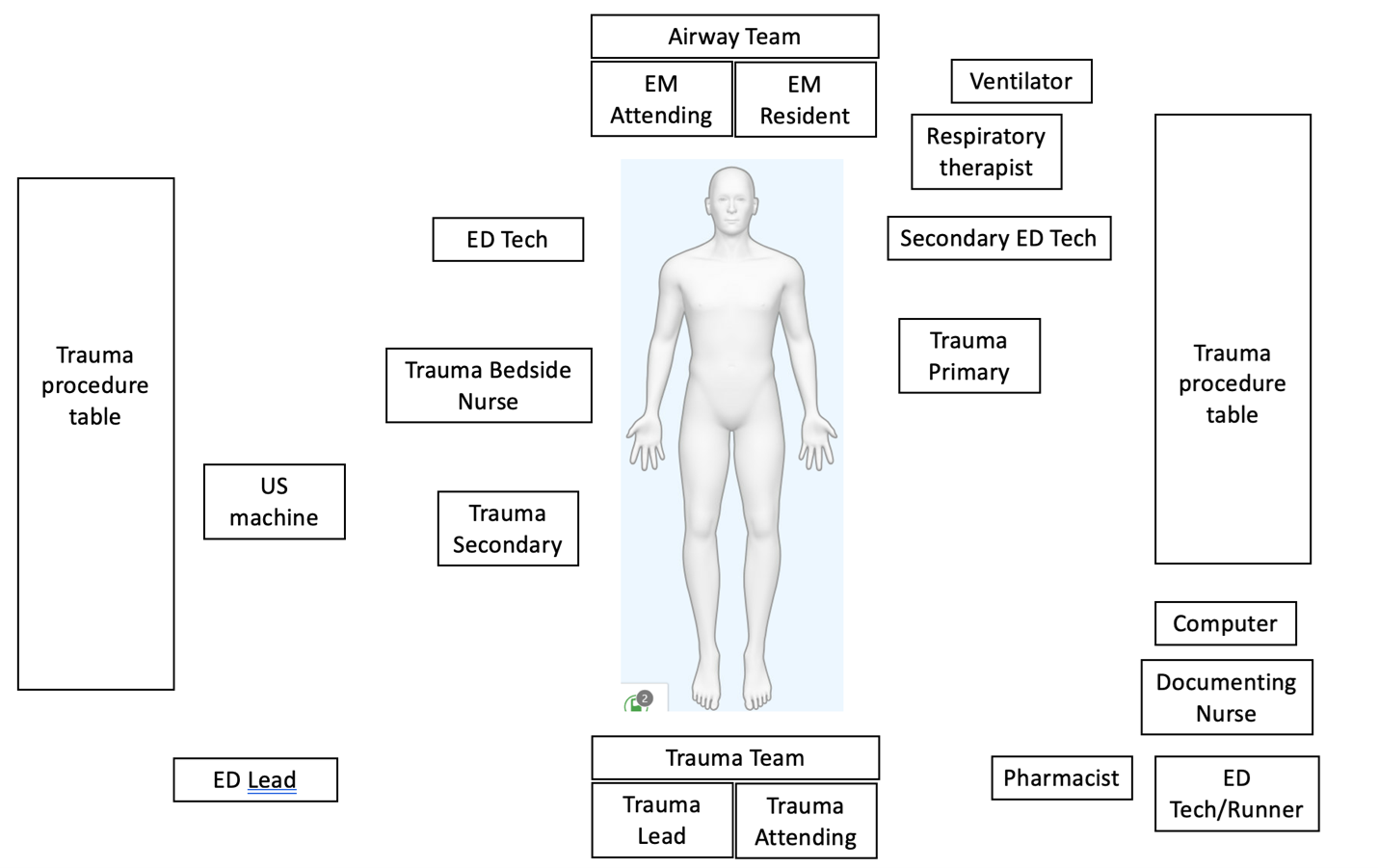](https://paths.trauma.ai/uploads/images/gallery/2024-10/picture1.png)
**Activation**
· Call is received from EMS en route. ED lead nurse completes intake. ED lead nurse confirms with ED attending/3rd year resident activation level. ED lead nurse calls dispatch to send out trauma activation page.
· If patient arrives and ED staff note that the activation was not sent via the paging system, another page should be sent, and the trauma attending should be notified via trauma phone call 402-990-5113
· If patient arrives and acuity does not match the trauma level (consult, limited or full), ED staff or Trauma team should notify charge to change activation level. Dispatch must be called to change trauma level and re-page activation level.
· If the patient is being sent from an outside hospital, they should have been identified and their name/MRN entered into EPIC for identification prior to arrival.
· If the patient is coming straight from scene, they should be given an “unidentified” name which should remain with the patient for 6 hours at which time their actual name can be entered into EPIC. (Designate for limited and full traumas) If the patient is still “unidentified” after 6 hours, their name should not be changed until full identification has been established. Refer to policy REG195 for information on how patients are identified.
**
**
**Prebrief**
· Prior to patient arrival, a pre- brief should be initiated and led by the Trauma or ED attending when the majority of the team has arrived in the trauma bay.
The Trauma Bedside Nurse should initiate this process before the patient’s arrival if not initiated by the Trauma/ED attending.
· The pre-brief consists of the introduction of the team members (name, role (see diagram above) & discipline) and includes known patient information, preparation (including assignment of procedures), and ensuring PPE.
\*\*
Recognizing trauma is unpredictable and can be fluid or change rapidly, if the Trauma or ED attending is unable to perform the pre-brief, the Trauma Bedside Nurse should perform the pre-brief prior to patient arrival.
\*\*
If not part of the primary trauma resuscitation team (depicted in the attached diagram and further described below), please stay behind Trauma attending and await to be called upon for assistance with patient care.
**Trauma Resuscitation Team/Personnel Responsibilities**
· **Trauma Team**
o **Trauma Lead**
§ Stands at the foot of the bed
§ Directs overall resuscitation (e.g. fluid resuscitation, blood products, interventions, disposition)
§ Responsible for majority of communication during resuscitation
§ Responsible for determining need for major invasive procedures performed (e.g. central lines, chest tubes, thoracotomy)
§ Accountable for determining whether the patient is safe for transport to CT scanner vs the need for immediate operative therapy for suspected injuries
§ Will not perform procedures in order to focus on directing the resuscitation (if Trauma Senior Resident or APP is needed in a procedure, then the direction of overall delegation will be turned over to the Trauma Attending)
§ May delegate additional tasks to others not explicitly mentioned here (ie. FAST exam, dressing wounds, etc.)
o **Trauma Surgery Attending**
§ Performs the Pre-brief and assigns defined team member roles, including possible procedures
§ Assumes overall responsibility for the resuscitation
§ Collaborates with ED Attending
§ Performs debrief per protocol with team following trauma resuscitation (must be performed with Trauma Bedside Nurse, at minimum)
· **Airway Team**
o **Airway Resident**
§ Stands at head of the bed
§ Is responsible for primary assessment of the A: Airway
§ Accountable for ensuring that the airway checklist is performed and that necessary materials needed for safe emergent intubation are available
§ Evaluates “B: breathing”, lung auscultation & tactile exam for subcutaneous emphysema.
If unable to do so, this will be the responsibility of the Primary Trauma Provider (description below).
§ Provides/ Discusses mechanical ventilator settings with RT
§ Performs the neurologic and D: Disability component of the primary survey.
If the patient needs to be intubated, all attempts should be made to assess the neurologic/disability (including GCS) prior to intubation.
§ Communicator to the patient. Relays key information to patient and obtains patient feedback.
§ Cervical spine stabilization during patient turning
§ Assist with secondary assessment of HEENT, neck, etc.
§ Once primary and secondary assessments are complete, may either perform or supervise the performance of procedures or FAST exam as designated by Trauma Team Lead.
o **EM Attending**
§ Responsible for supervising the ED Resident during Primary Assessment of the airway
§ Supervises or assumes management of the airways (including induction plan & techniques)
§ Assumes the role of supervising the Trauma Team when the Trauma attending is not available or during multiple traumas
§ Supervises doctor delegated to perform FAST exam
§ Collaborates with Trauma attending and rest of trauma team once airway is secured
· **Trauma Primary Provider**
o Starts on the left side of the patient, but is free to move about the patient to perform adequate primary and secondary survey
o Responsible for C: Circulation and E: Exposure of the patient by removing clothing.
If the Airway Resident unable to complete their portion of the primary survey (ie. B: Breathing), this becomes the responsibility of the Trauma Primary Provider
o Responsible for secondary survey assessment
o Performs all procedures as delegated by Trauma Team (IO, CVC, thoracostomy tubes, arterial line) under Trauma Attending Supervision
o Additional responsibilities as delegated by Trauma Team
o “Travels” with the patient to CT or the operating room
o Responsible for keeping the Trauma & ED attending, and Trauma Lead informed of patient’s condition and any diagnostic findings
o May perform other tasks as delegated by Trauma/ED attending
· **Trauma Secondary Provider**
o Starts on the right side of the patient, near foot of patient (see diagram)
o Assist with E: Exposure of patient as needed- needs to carry trauma shears
o Assist with secondary survey as needed
o Assist with procedures as needed.
If multiple procedures are needed to be performed at the same time, the Trauma Secondary Provider will be responsible for procedures the Trauma Primary Provider is not performing which will be assigned and supervised by the Trauma/ED attending.
o Trauma Secondary Provider will complete the FAST exam, when indicated, as long as that provider is competent to complete the procedure.
If not, EM resident or faculty will move to right of patient to complete the FAST exam.
o May perform other tasks as delegated by Trauma Team
· **Trauma Techs**
o One stands to the mid/upper right of the patient
o Second stands to the upper left of the patient if present
o Pulls red cart to bedside
o Obtains first set of vitals (including temp) within 30 minutes
o Places patient on cardiac monitor
o Helps remove clothing
o Pulls supplies as needed (see separate checklist for supplies to be pulled before an Agonal Resuscitation)
o Set up necessary equipment for procedures (ie: chest tube, splinting, lac repair)
o Assists with bedside procedures as directed by trauma surgeon, assists nursing staff as called upon, otherwise steps away from bedside once tasks complete
o Performs CPR if necessary
o Completes patient belonging list
o Reconciles supply checklist following trauma resuscitation completion
o Restocks supplies/supply carts
· **Trauma Bedside Nurse (TNS trained)**
o Initiates the Prebrief before patient’s arrival in the trauma bay
§ If Trauma and EM attendings are not present, the ED Trauma Lead Nurse (or ED Lead) should perform the prebrief, including assignment of defined team member roles
o Directs care to trauma tech
o Assists with retrieval of equipment
o Assists with crowd control
o Confirms EMS IV patency and obtains 2
nd IV access, if able
o Inserts foley/NG/OG if indicated
o Administers medications as ordered
o Places patient on the telemetry monitor (shared with tech)
o Primes tubing for Belmont prior to patient’s arrival, when applicable
o Administers blood products and fluids as ordered
o Places patient on defibrillator pads
o “Travels” with the patient to CT, OR or IR
o Assists with obtaining laboratory blood vials
o Performs debrief with team following trauma resuscitation (must be performed with Trauma Attending, at minimum)
o \*\*\*In complex traumas/Code 99s/CPR in progress situations, more than 1 Trauma Bedside Nurse is required.
In these cases, another bedside nurse will assist with tasks listed above under the leadership of the ED Lead Nurse
· **Documenting Nurse**
o Responsible for keeping a written record of the resuscitation events on trauma narrator
o Maintains closed loop communication with entire team
o Assists with crowd control
· **Additional Trauma or EM residents, APPs, medical students observing or other learners**
o Starts behind the “red line”
o Are not immediately involved in the trauma resuscitation unless there is a vacant role
o Are recruited as needed for the care of the patient
o May assist with electronic orders, gathering equipment
· **Respiratory Therapist**
o Assist with intubation
o Provide ETCO2 monitoring post intubation
o Secure ETT
o Provide suctioning
o Assist with vitals and monitoring the patient (SpO2, HR, RR, measured parameters, etc.)
o Provide transport to CT/MRI (NIV, MV, etc.)
o Restock/check airway cart
· **Pharmacist**
o Prepares drugs, assures appropriate doses, identifies potential interactions, provides clinical support
o Serves as timekeeper during codes
o Operates defibrillator machine upon guidance of Trauma and EM attendings
**Additional Information**
**Who is the Trauma Team Lead?**
The Trauma Team Lead is the General Surgery resident when present.
During educational time or when General Surgery resident is not present, it is the ACS APP or Trauma attending.
**Who is the Airway Resident?**
The Airway Resident is the EM PGY 2 or 3 when present.
During educational time when a senior EM resident is not present, it is the EM attending.
If EM is not available, Anesthesia will manage the airway.
**Who is Trauma Primary?**
The Trauma Primary is the General Surgery resident, off service resident rotating on the trauma service, or available ED resident when present.
During educational time or when General Surgery resident is not present, it is the ACS APP.
Residents or APPs involved in the care of the trauma patient must be present at the time of prebrief and arrival of the trauma patient and remain until the initial resuscitation efforts are complete.
**Who is Trauma Secondary?**
The Trauma Secondary is the General Surgery resident, or off service resident rotating on the trauma team, when present.
This role may also be filled by the ER resident, if present and in PPE at the time of the prebrief.
During educational time or when General Surgery or ER resident is not present, it is the ACS APP.
A medical student rotating on trauma or in the ER may assist in this role.
**It seems like the Primary Survey is divided between 2 different providers?**
That is correct.
The Airway Resident tasked with airway management, which is closely tied to the pulmonary exam, will perform A: & B: Trauma Primary, who has access to the extremities to evaluate distal pulses and cap refill, fills the C: component. Disability (D:) is then assessed by the Airway Resident who can easily examine the pupils and talk with the patient to obtain a GCS score. The secondary exam then returns to Trauma Primary and Secondary providers.
ALL findings should be CALLED OUT with closed loop communication with the Trauma Lead and ED Nurse Scribe.
ATLS primary exam consists of ABCDE, which should be called out first and reported in that order.
The findings in the secondary survey should not be called out until the primary survey is completed.
**What is the role of Trauma Secondary if there are no procedures required on the right?**
Do not under-estimate the importance of the physical exam and participation in the work up of a trauma patient. It is imperative that the Trauma Secondary is learning from & collaborating with the Trauma Team Lead in preparation for them to ultimately assume this role. They are also integral in CT interpretation, and “closing the loop” on the patient disposition after CT scan interpretation.
**What if EM attending or trauma attending has to perform a procedure?**
If either attending is pulled into a procedure, or is called away from bedside to attend to another patient, the other attending should take over as “in charge”.
Both attendings should remain fully available during the resuscitation to supervise residents and APPs involved in the resuscitation.
If an attending is involved in a procedure and can no longer adequately supervise, then additional attending support (either EM or trauma) should be called upon.
**Who is “In Charge” of the whole Process?**
Trauma bay resuscitations are a joint collaboration between the ED & Trauma attendings and teams.
Patient Management Guidelines are based on medical evidence and/or consensus of medical providers at Nebraska Medicine, and are intended to be a guide for the trauma resuscitation team.
Final management decisions are at the discretion and responsibility of the admitting physician.
\*\*\*Note: This is not a comprehensive document that addresses all possible situations, and challenges or desired changes will work through the Trauma Resuscitation Committee.
- CXR for all blunt trauma patients, PXR for pts with unstable pelvis or pelvic pain (discuss with attending), FAST for blunt unstable or penetrating wounds to cardiac box.
- Penetrating trauma patients need early exposure to look for wounds. Wounds should be marked with paper clips, then x-rays should be obtained of all cavities with a wound.
- CXR must be reviewed by senior resident before CT
- Secondary survey then CTs (only when patient is stable)
- Trauma team member must accompany patient to CT
- Follow up FINAL reads on all patients; go to radiology to review scans
- ADD PATIENT TO Epic Trauma list
**
H&P and Progress Notes **
- Full = Full trauma activation
- Limited = Limited trauma activation
- Consult = No trauma activation but seen in the ED. This includes patient worked by EM first AND transfers from outside that are seen in the ED by trauma. The ED does not see transfers that are “consults.”
- Direct Admit = Transfer from outside that goes directly to an inpatient bed, never seen in ED at any point.
- Any trauma patient with a traumatic injury or physical/social circumstance which requires observation is admitted to Trauma
**Tertiary Exams **