# Assessing Capacity
Why assess capacity? Informed consent promotes individual autonomy and fosters rational decision-making, and is founded on the right of self-determination and physician’s fiduciary responsibility to the patient. Informed consent requires disclosure of information, voluntary choice and capacity to decide. Therefore, determining a patient’s capacity is of utmost importance during a patient’s hospitalization.
Capacity refers to the ability to accept or refuse treatment recommendations. Capacity is determined by a clinician upon specific elements of a mental status exam. Capacity does not have to be a psychologist or psychiatrist.
Capacity differs from competency. Competency is defined as “the ability of an individual to participate in legal proceedings”. Legal competence is presumed - to disprove an individual's competence requires a hearing and presentation of evidence. Competence is determined by a judge. This legal determination is never determined by medical providers. Because this determination is not made by providers we will not use this term further in this pathway.
1. Any patient who is observed to have functional deficits judged to be sufficiently great that the patient currently cannot meet the demands of a specific decision making situation and its inherent consequences SHOULD be assessed for capacity.
2. Capacity is determined for individual decisions, and may vary by risk involved. For example, a patient may have capacity to refuse a bowel regimen but lack capacity to leave the hospital against medical advice.
3. Capacity should be reassessed as decision-making abilities deteriorate or improve. Capacity also needs to be documented each time it is assessed.
4. Speech therapy can provide the treatment team with additional information and expertise on cognition, to assist with the capacity assessment. However, cognition testing is not required for capacity assessment.
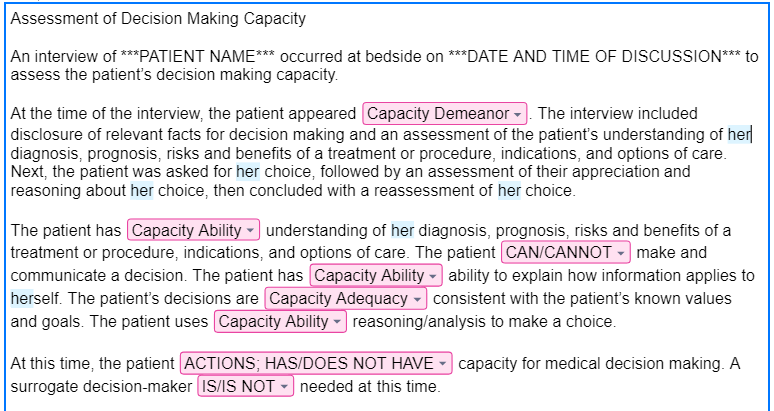
Discussions regarding a patient's capacity to make a decision should be documented in the electronic medical record in a short progress note using the assessing capacity note template.
The template can be found using the dot phrase = **.acscapacityassessment**
Example of note template in electronic medical record:
[](https://paths.trauma.ai/uploads/images/gallery/2023-11/image.png)