# Evaluation and Management of Hepatic Injury

#### Purpose

<span style="font-family: 'Arial',sans-serif; mso-fareast-font-family: 'Times New Roman'; color: #444444; mso-font-kerning: 0pt; mso-ligatures: none;">The liver is the most frequently injured abdominal organ. Most injuries are minor and can heal spontaneously without operative management. Unrecognized injury can be a cause of preventable death following trauma. The following guidelines outline the approach that should be taken when evaluating and managing a trauma patient with hepatic injury and the decision-making process between operative and non-operative management.</span>

#### <span style="font-family: 'Arial',sans-serif; mso-fareast-font-family: 'Times New Roman'; color: #444444; mso-font-kerning: 0pt; mso-ligatures: none;">Background/Definitions </span>

<span style="font-family: 'Arial',sans-serif; color: black; background: white;">During the last century, the management of blunt force trauma to the liver has changed dramatically. A shift away from operative management has resulted in a decline in mortality. The current nonoperative paradigm in adults was encouraged by the success of nonoperative management of solid organ injuries in hemodynamically stable children. </span><span style="font-family: 'Arial',sans-serif; color: black;">As early as 1960, Shaftan advocated “observant and expectant treatment” rather than mandatory laparotomy in the management of penetrating abdominal injury</span><span style="font-family: 'Arial',sans-serif; color: black;">. This was reinforced in 1969 by Nance and Cohn for the management of abdominal stab wounds.<span style="mso-spacerun: yes;"> </span><span style="background: white;">The advantages of nonoperative management include lower hospital cost, earlier discharge, avoiding nontherapeutic laparotomies, fewer intra-abdominal complications, and reduced transfusion rates. </span>Gunshot wounds to the abdomen, however, are still commonly treated with mandatory exploration because of multiple reports emphasizing a high incidence of intra-abdominal injuries and the complications of a missed injury or an injury delayed in recognition and treatment. Multiple studies and review of National Trauma database have demonstrated that only 13.7% of hepatic injuries are now managed operatively.<span style="background: white;"> </span>Complications develop in 2.5 to 41% of all trauma patients undergoing unnecessary laparotomy, and small bowel obstruction, pneumothorax, ileus, wound infection, myocardial infarction, visceral injury, and even death have been reported secondary to unnecessary laparotomy. It is important to recognize the importance of different mechanisms of penetrating injury (stab versus gunshot versus shotgun wounds), the velocity of the agent (low versus high) as well as the different regions of the abdomen (intraperitoneal, retroperitoneal, and thoracoabdominal areas).</span>

<span style="font-family: 'Arial',sans-serif; color: black; background: white;">These issues were first addressed by the Eastern Association for the Surgery of Trauma (EAST) in the Practice Management Guidelines for Non-operative Management of Blunt Injury to the Liver and Spleen published online in 2003. The practice management guideline update was split into separate recommendations for the nonoperative management of blunt hepatic and splenic injuries in adult trauma patients, with the last set of guidelines being published in 2012 for blunt hepatic injuries and in 2010 for penetrating injuries. </span>

<span style="font-family: 'Arial',sans-serif; mso-fareast-font-family: 'Times New Roman'; color: #444444; mso-font-kerning: 0pt; mso-ligatures: none;"> </span>

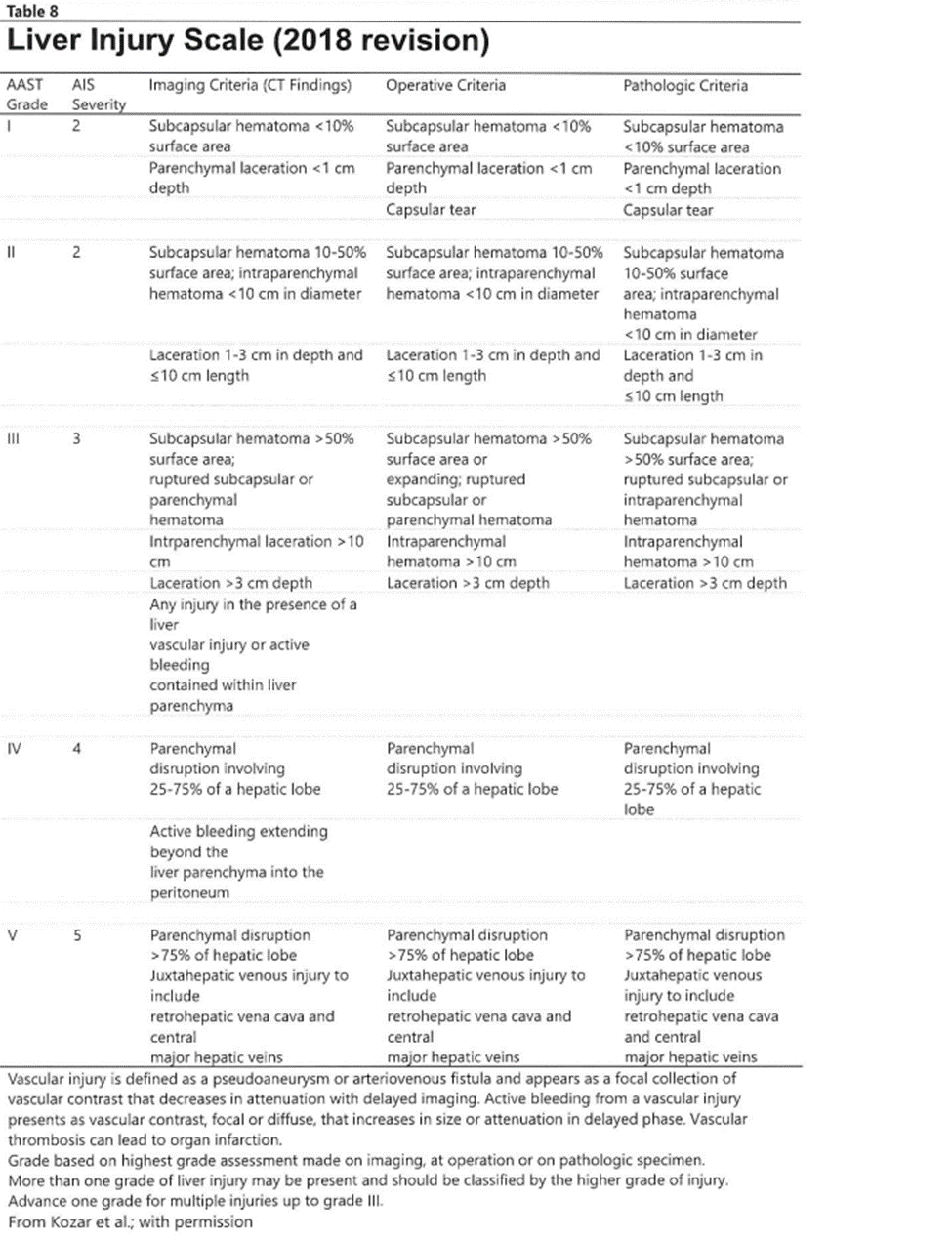
<span style="font-family: 'Arial',sans-serif; color: #444444; background: white;">Hepatic injuries are classified by a grading system established by the AAST (American Association for the Surgery of Trauma). In general, the higher the grade equals more severe injury and potential for associated morbidity and mortality.<span style="border: none windowtext 1.0pt; mso-border-alt: none windowtext 0in; padding: 0in;"> </span></span>

<span style="font-family: 'Arial',sans-serif; color: #444444; background: white;"><span style="border: none windowtext 1.0pt; mso-border-alt: none windowtext 0in; padding: 0in;">![](https://paths.trauma.ai/uploads/images/gallery/2024-02/embedded-image-rok0v23c.png)</span></span>

<span style="font-family: 'Arial',sans-serif; color: #444444; background: white;"><span style="border: none windowtext 1.0pt; mso-border-alt: none windowtext 0in; padding: 0in;"><span style="font-size: 11.0pt; line-height: 107%; font-family: 'Arial',sans-serif; mso-fareast-font-family: 'Times New Roman'; color: #444444; mso-font-kerning: 0pt; mso-ligatures: none; mso-ansi-language: EN-US; mso-fareast-language: EN-US; mso-bidi-language: AR-SA;">[https://www.aast.org/resources-detail/injury-scoring-scale#liver](https://www.aast.org/resources-detail/injury-scoring-scale#liver) </span></span></span>

#### Guideline Inclusion Criteria 

- <span style="font-family: 'Arial',sans-serif; mso-fareast-font-family: 'Times New Roman'; mso-font-kerning: 0pt; mso-ligatures: none;">All trauma patients sustaining abdominal trauma should be evaluated for potential hepatic injury.</span>

#### <span style="font-family: 'Arial',sans-serif; mso-fareast-font-family: 'Times New Roman'; mso-font-kerning: 0pt; mso-ligatures: none;">Guideline Exclusion Criteria</span>

- <span style="font-family: 'Arial',sans-serif; mso-fareast-font-family: 'Times New Roman'; mso-font-kerning: 0pt; mso-ligatures: none;">Pediatric patients &lt;15 yrs of age.</span>

#### <span style="font-family: 'Arial',sans-serif; mso-fareast-font-family: 'Times New Roman'; mso-font-kerning: 0pt; mso-ligatures: none;">Diagnostic Evaluation</span>

- <span style="font-family: 'Arial',sans-serif; mso-fareast-font-family: 'Times New Roman'; mso-font-kerning: 0pt; mso-ligatures: none;">All trauma patients should be initially evaluated per ATLS guidelines with work-up as mechanism and clinical presentation dictate.</span>
- <span style="font-family: 'Arial',sans-serif; mso-fareast-font-family: 'Times New Roman'; mso-font-kerning: 0pt; mso-ligatures: none;">Resuscitative measures should be initiated as clinical status/presentation dictates.</span>
- <span style="font-family: 'Arial',sans-serif; mso-fareast-font-family: 'Times New Roman'; mso-font-kerning: 0pt; mso-ligatures: none;">Labs, imaging and additional tests should be obtained as clinical status/presentation dictates.</span>
- <span style="font-family: 'Arial',sans-serif; mso-fareast-font-family: 'Times New Roman'; mso-font-kerning: 0pt; mso-ligatures: none;">If a patient is hemodynamically UNSTABLE, minimal testing/imaging should occur prior to interventions for hemorrhage control.</span>

#### <span style="font-family: 'Arial',sans-serif; mso-fareast-font-family: 'Times New Roman'; mso-font-kerning: 0pt; mso-ligatures: none;">Practice Recommendations for Management</span>

- <span style="font-family: 'Arial',sans-serif; mso-fareast-font-family: 'Times New Roman'; mso-font-kerning: 0pt; mso-ligatures: none;">Once hepatic injury is suspected and/or confirmed, management of that injury is dictated largely by the clinical status of the patient.</span>

- - - <span style="font-family: 'Arial',sans-serif; mso-fareast-font-family: 'Times New Roman'; mso-font-kerning: 0pt; mso-ligatures: none;">If a patient is hemodynamically **<span style="border: none windowtext 1.0pt; mso-border-alt: none windowtext 0in; padding: 0in;">UNSTABLE</span>**:</span>
            - - <span style="font-family: 'Arial',sans-serif; mso-fareast-font-family: 'Times New Roman'; mso-font-kerning: 0pt; mso-ligatures: none;">Initiate/continue resuscitative measures.</span>
                - <span style="font-family: 'Arial',sans-serif; mso-fareast-font-family: 'Times New Roman'; mso-font-kerning: 0pt; mso-ligatures: none;">Obtain an eFAST exam.</span>
                - <span style="font-family: 'Arial',sans-serif; mso-fareast-font-family: 'Times New Roman'; mso-font-kerning: 0pt; mso-ligatures: none;">If eFAST is positive, proceed to OR for surgical exploration.</span>
        - <span style="font-family: 'Arial',sans-serif; mso-fareast-font-family: 'Times New Roman'; mso-font-kerning: 0pt; mso-ligatures: none;">If a patient is hemodynamically **<span style="border: none windowtext 1.0pt; mso-border-alt: none windowtext 0in; padding: 0in;">STABLE</span>**:</span>
            - - <span style="font-family: 'Arial',sans-serif; mso-fareast-font-family: 'Times New Roman'; mso-font-kerning: 0pt; mso-ligatures: none;">May continue with evaluation and work-up as mechanism and presentation dictate.</span>
                - <span style="font-family: 'Arial',sans-serif; mso-fareast-font-family: 'Times New Roman'; mso-font-kerning: 0pt; mso-ligatures: none;">Obtain imaging as indicated, including a multi-phase CT abd/pelvis with IV contrast.</span>
                - <span style="font-family: 'Arial',sans-serif; mso-fareast-font-family: 'Times New Roman'; mso-font-kerning: 0pt; mso-ligatures: none;">Determine appropriate management strategy based on grade of injury, presence of blush/extravasation on imaging, and clinical status and injury burden of patient.</span>

- <u><span style="font-family: 'Arial',sans-serif; mso-fareast-font-family: 'Times New Roman'; border: none windowtext 1.0pt; mso-border-alt: none windowtext 0in; padding: 0in; mso-font-kerning: 0pt; mso-ligatures: none;">Operative Management</span></u>
    - - - <span style="font-family: 'Arial',sans-serif; mso-fareast-font-family: 'Times New Roman'; mso-font-kerning: 0pt; mso-ligatures: none;">Should be used in all patients who are hemodynamically unstable or those with peritonitis on exam.</span>
            - <span style="font-family: 'Arial',sans-serif; mso-fareast-font-family: 'Times New Roman'; mso-font-kerning: 0pt; mso-ligatures: none;">Should be considered in patients who are transient responders to resuscitation or in those with injury burden in which hypotension secondary to hemorrhagic shock would be detrimental.</span>
            - <span style="font-family: 'Arial',sans-serif; mso-fareast-font-family: 'Times New Roman'; mso-font-kerning: 0pt; mso-ligatures: none;">Operative plan should be exploratory laparotomy for trauma with consideration of cauterization, topical hemostatic agents, hepatorrhaphy or packing +/- endovascular procedures. </span>
            - <span style="font-family: 'Arial',sans-serif; color: black; background: white;">Diagnostic laparoscopy may be considered as a tool to evaluate diaphragmatic lacerations as well as peritoneal penetration.</span>
            - <span style="font-family: 'Arial',sans-serif; color: black; background: white;">In severe/high grade liver injuries, interventional radiology for angioembolization may also be considered for hemorrhage control in conjunction with operative interventions.</span>

- <u><span style="font-family: 'Arial',sans-serif; mso-fareast-font-family: 'Times New Roman'; border: none windowtext 1.0pt; mso-border-alt: none windowtext 0in; padding: 0in; mso-font-kerning: 0pt; mso-ligatures: none;">IR Angioembolization</span></u>
    - - <span style="font-family: 'Arial',sans-serif; mso-fareast-font-family: 'Times New Roman'; mso-font-kerning: 0pt; mso-ligatures: none;">Should be considered in patients who are transient responders to resuscitation, those with evidence of active extravasation/blush on CT abd/pelvis, those with high grade injuries (Grade III-V) or those with injury burden (e.g. head injury) in which hypotension secondary to hemorrhagic shock would be detrimental.</span>

- <u><span style="font-family: 'Arial',sans-serif; mso-fareast-font-family: 'Times New Roman'; border: none windowtext 1.0pt; mso-border-alt: none windowtext 0in; padding: 0in; mso-font-kerning: 0pt; mso-ligatures: none;">Non-operative Management</span></u>
    - - <span style="font-family: 'Arial',sans-serif; mso-fareast-font-family: 'Times New Roman'; mso-font-kerning: 0pt; mso-ligatures: none;">Non-operative management of hepatic injuries should ONLY be considered in hemodynamically stable patients.</span>
        - <span style="font-family: 'Arial',sans-serif; mso-fareast-font-family: 'Times New Roman'; mso-font-kerning: 0pt; mso-ligatures: none;">Patients with penetrating injury isolated to the right upper quadrant of the abdomen may be managed without laparotomy in the presence of stable vital signs, reliable examination and minimal to no abdominal tenderness. </span>
        - <span style="font-family: 'Arial',sans-serif; mso-fareast-font-family: 'Times New Roman'; mso-font-kerning: 0pt; mso-ligatures: none;">The severity of hepatic injury (as suggested by CT grade or degree of hemoperitoneum), neurologic status, age of more than 55 years, and/or the presence of associated injuries are not absolute contraindications to a trial of nonoperative management in a hemodynamically stable patient. </span>
        - <span style="font-family: 'Arial',sans-serif; mso-fareast-font-family: 'Times New Roman'; mso-font-kerning: 0pt; mso-ligatures: none;">Patients undergoing non-operative management should be monitored closely for deterioration in clinical status suggestive of ongoing hemorrhage (i.e. failure of non-operative management) with vitals per unit protocol, serial labs, abdominal exams and repeat imaging as indicated. </span>
        - <span style="font-family: 'Arial',sans-serif; mso-fareast-font-family: 'Times New Roman'; mso-font-kerning: 0pt; mso-ligatures: none;">Interventional modalities including endoscopic retrograde cholangiopancreatography (ERCP), angiography, laparoscopy, or percutaneous drainage may be required to manage complications (bile leak, biloma, bile peritonitis, bilious ascities, and hemobilia) </span>
        - <span style="font-family: 'Arial',sans-serif; mso-fareast-font-family: 'Times New Roman'; mso-font-kerning: 0pt; mso-ligatures: none;">Bedrest is not routinely indicated for blunt hepatic injuries that are managed non-operatively. In general, patients may be activity as tolerated unless bedrest is required for a concurrent injury or at trauma attending's discretion. </span>
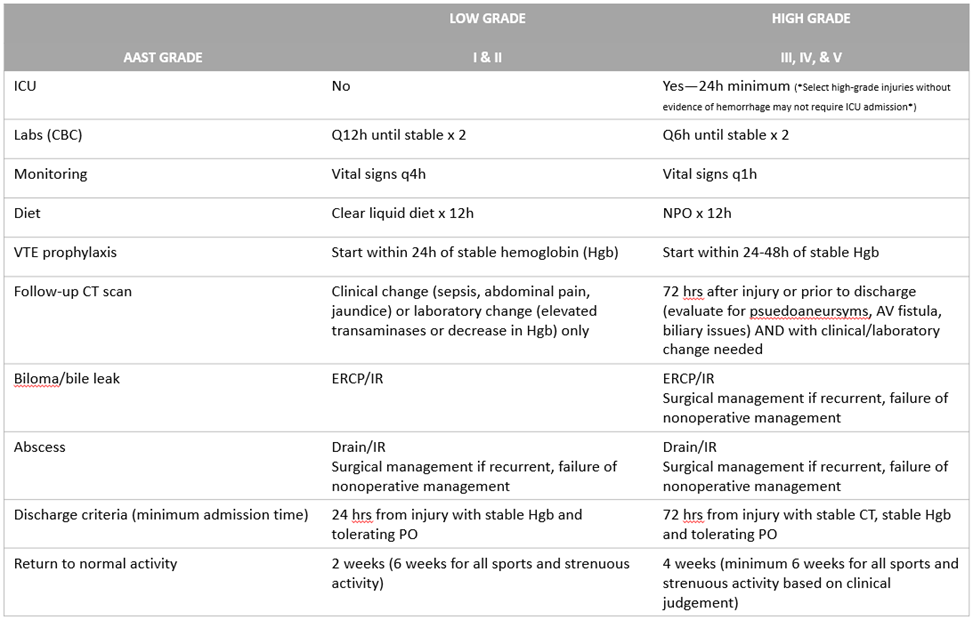
        - <span style="font-family: 'Arial',sans-serif; mso-fareast-font-family: 'Times New Roman'; mso-font-kerning: 0pt; mso-ligatures: none;">Admission level of care will be at the trauma attending's discretion. In general, higher grade injuries (III, IV, V) should initially be monitored in the ICU or Step Down Unit and lower grade injuries (I, II) be initially monitored on the floor or Step Down Unit depending on the clinical status and injury burden of the patient. </span>
        - <span style="font-family: 'Arial',sans-serif; mso-fareast-font-family: 'Times New Roman'; mso-font-kerning: 0pt; mso-ligatures: none;">Suggested non-operative management strategy is as follows (Table 1): </span>

<span style="font-family: 'Arial',sans-serif; mso-fareast-font-family: 'Times New Roman'; mso-font-kerning: 0pt; mso-ligatures: none;">Table1. Blunt Hepatic Injury Guidelines for Nonoperative and Postintervention Management</span>

<span style="font-family: 'Arial',sans-serif; mso-fareast-font-family: 'Times New Roman'; mso-font-kerning: 0pt; mso-ligatures: none;">![](https://paths.trauma.ai/uploads/images/gallery/2024-02/embedded-image-5vctx0t4.png)</span>

- <span style="font-size: 10.5pt; font-family: 'Arial',sans-serif; mso-fareast-font-family: 'Times New Roman'; mso-font-kerning: 0pt; mso-ligatures: none;">Repeat imaging for hepatic injuries managed non-operatively</span>
- <span style="font-family: 'Arial',sans-serif; mso-fareast-font-family: 'Times New Roman'; mso-font-kerning: 0pt; mso-ligatures: none;">Clinical factors such as a persistent systemic inflammatory response, increasing persistent abdominal pain, jaundice, or an otherwise unexplained drop in hemoglobin should prompt reevaluation by CT scan.</span>
- <span style="font-family: 'Arial',sans-serif;">A repeat multi-phase CT abd/pelvis with IV contrast should be obtained for all Grade III or higher blunt hepatic injuries between 3-5 days post injury or prior to discharge to evaluate for development of post-traumatic pseudoaneurysms, AV fistulas or biliary issues</span><span style="font-family: 'Arial',sans-serif; color: #1f1f1f;">.</span>


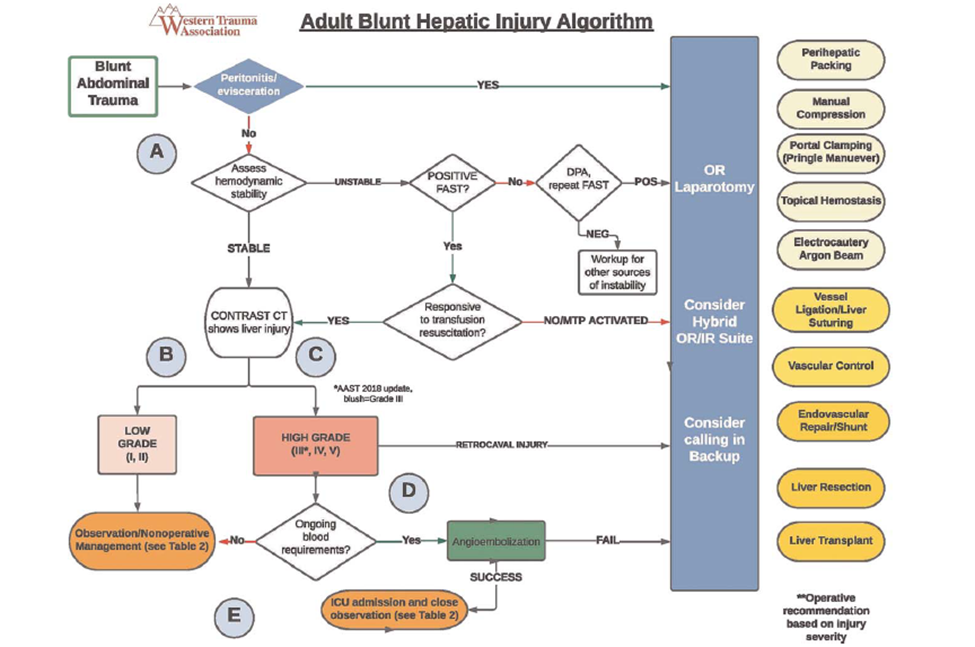
<span style="font-size: 10.5pt; font-family: 'Arial',sans-serif; mso-fareast-font-family: 'Times New Roman'; color: #444444; mso-font-kerning: 0pt; mso-ligatures: none;">Figure 1. Western Trauma Association algorithm for the diagnosis and management of blunt hepatic injury in adults. Circled letters correspond to lettered section in the articles text. OR, operating room; IR, interventional radiology. </span><span style="font-size: 9.0pt; font-family: 'Arial',sans-serif; mso-fareast-font-family: 'Times New Roman'; color: #444444; mso-font-kerning: 0pt; mso-ligatures: none;">(</span><span style="font-size: 9.0pt; font-family: 'Arial',sans-serif; color: black; mso-color-alt: windowtext;">Keric N, Shatz DV, Schellenberg M, et al. Adult blunt hepatic injury: A Western Trauma Association critical decisions algorithm. *J Trauma Acute Care Surg.* 2024 Jan 1;96(1):123-128. Doi:10.1097/TA</span><span style="font-size: 9.0pt; font-family: 'Arial',sans-serif; color: #212121; background: white;">.0000000000004141. Epub 2023 Sep 25. PMID: 37747241)</span>
<span style="font-size: 9.0pt; font-family: 'Arial',sans-serif; color: #212121; background: white;">![](https://paths.trauma.ai/uploads/images/gallery/2024-02/embedded-image-lntsaxem.png)</span>

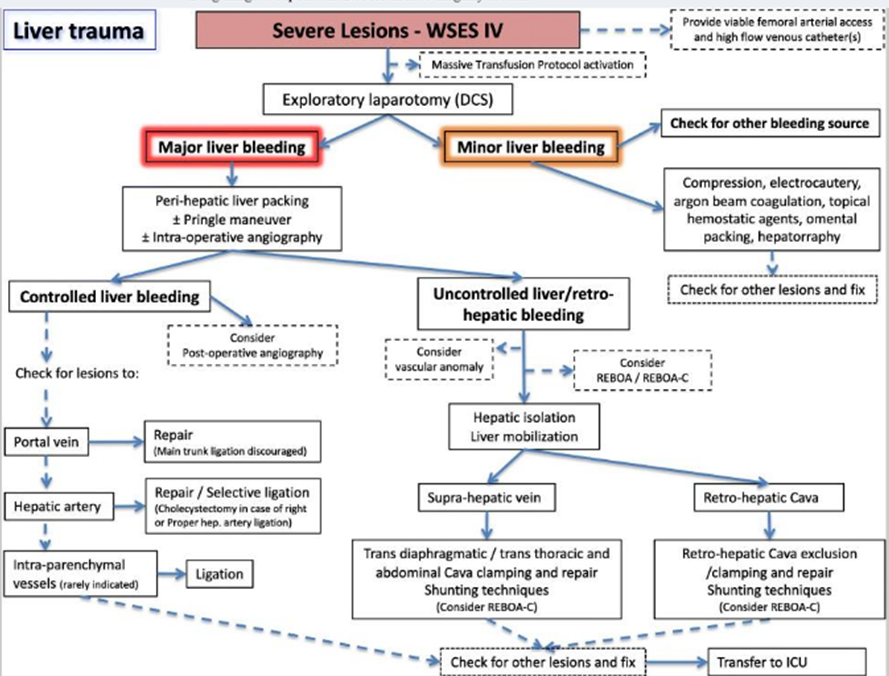
<span style="font-size: 10.5pt; font-family: 'Arial',sans-serif; mso-fareast-font-family: 'Times New Roman'; color: #444444; mso-font-kerning: 0pt; mso-ligatures: none;">Figure 2. Operative management of blunt hepatic injury in adults.</span>

<span style="font-size: 10.5pt; font-family: 'Arial',sans-serif; mso-fareast-font-family: 'Times New Roman'; color: #444444; mso-font-kerning: 0pt; mso-ligatures: none;">![](https://paths.trauma.ai/uploads/images/gallery/2024-02/embedded-image-rcqqqpm3.png)</span>

- <u><span style="font-size: 11.0pt; font-family: 'Arial',sans-serif; color: #444444; border: none windowtext 1.0pt; mso-border-alt: none windowtext 0in; padding: 0in;">Follow-up Care</span></u>
    - - All patients with hepatic injury should follow-up in trauma clinic 1-2 weeks following discharge pending clinical status at time of discharge and hospital length of stay following injury.

#### Outcome Measures and Guideline Adhearance

- <span style="font-family: 'Arial',sans-serif; mso-fareast-font-family: 'Times New Roman'; mso-font-kerning: 0pt; mso-ligatures: none;">Time to OR/IR and interventions for all hemodynamically unstable patients will be tracked through our performance improvement process/initiatives.</span>
- <span style="font-family: 'Arial',sans-serif; mso-fareast-font-family: 'Times New Roman'; mso-font-kerning: 0pt; mso-ligatures: none;">Patients failing non-operative management (i.e. those requiring IR angioembolization or exploratory laparotomy in a delayed fashion) will be tracked through our performance improvement process/initiatives.</span>

#### <span style="font-family: 'Arial',sans-serif; mso-fareast-font-family: 'Times New Roman'; mso-font-kerning: 0pt; mso-ligatures: none;">Key Contributors</span>

<span style="font-size: 10.5pt; font-family: 'Arial',sans-serif; mso-fareast-font-family: 'Times New Roman'; color: #444444; border: none windowtext 1.0pt; mso-border-alt: none windowtext 0in; padding: 0in; mso-font-kerning: 0pt; mso-ligatures: none;">·</span><span style="font-size: 7.0pt; font-family: 'Arial',sans-serif; mso-fareast-font-family: 'Times New Roman'; color: #444444; border: none windowtext 1.0pt; mso-border-alt: none windowtext 0in; padding: 0in; mso-font-kerning: 0pt; mso-ligatures: none;"> </span><span style="font-family: 'Arial',sans-serif; mso-fareast-font-family: 'Times New Roman'; color: #444444; mso-font-kerning: 0pt; mso-ligatures: none;">Gina Lamb, MD <span style="border: none windowtext 1.0pt; mso-border-alt: none windowtext 0in; padding: 0in;">| Division of Acute Care Surgery, Faculty | Principle Author</span></span>

<span style="font-family: 'Arial',sans-serif; mso-fareast-font-family: 'Times New Roman'; color: #444444; border: none windowtext 1.0pt; mso-border-alt: none windowtext 0in; padding: 0in; mso-font-kerning: 0pt; mso-ligatures: none;"><span style="mso-tab-count: 1;"> </span>Emily Cantrell, MD</span><span style="font-family: 'Arial',sans-serif; mso-fareast-font-family: 'Times New Roman'; color: #444444; mso-font-kerning: 0pt; mso-ligatures: none;"> <span style="border: none windowtext 1.0pt; mso-border-alt: none windowtext 0in; padding: 0in;">| Division of Acute Care Surgery, Faculty | Author</span></span>

#### <span style="font-family: 'Arial',sans-serif; mso-fareast-font-family: 'Times New Roman'; mso-font-kerning: 0pt; mso-ligatures: none;">Last Updated</span>

<span style="font-family: 'Arial',sans-serif; mso-fareast-font-family: 'Times New Roman'; mso-font-kerning: 0pt; mso-ligatures: none;">February, 2024</span>

#### <span style="font-family: 'Arial',sans-serif; mso-fareast-font-family: 'Times New Roman'; mso-font-kerning: 0pt; mso-ligatures: none;">References</span>

1. <span style="font-size: 11.0pt; font-family: 'Arial',sans-serif;">Tinkoff G, Esposito T, Reed J, et al. American Association for the Surgery of Trauma Organ Injury Scale I: spleen, liver, and kidney, validation based on the National Trauma Data Bank. J Am Coll Surg. 2008;207:646–655</span>
2. <span style="font-size: 11.0pt; font-family: 'Arial',sans-serif;">Como J, Bokhari F,<span style="mso-spacerun: yes;"> </span>et al. Practice Management Guidelines for Selective Nonoperative Management of Penetrating Abdominal Trauma. J Trauma. 2010;68: 721–733</span>
3. <span style="font-size: 11.0pt; font-family: 'Arial',sans-serif; color: black; mso-color-alt: windowtext; background: white;">Stassen, N, Bhullar, I, et al. </span><span style="font-size: 11.0pt; font-family: 'Arial',sans-serif; color: black; mso-color-alt: windowtext;">Nonoperative management of blunt hepatic injury. An Eastern Association for the Surgery of Trauma practice management guideline. <span class="ej-journal-name">*<span style="background: white;">Journal of Trauma and Acute Care Surgery </span>*</span></span><span style="color: black; mso-color-alt: windowtext;">[<span style="font-size: 11.0pt; font-family: 'Arial',sans-serif;">73(5):p S288-S293, November 2012.</span>](https://journals.lww.com/jtrauma/toc/2012/11004)</span><span style="font-size: 11.0pt; font-family: 'Arial',sans-serif; color: black; mso-color-alt: windowtext; background: white;"> </span>
4. <span style="font-size: 11.0pt; font-family: 'Arial',sans-serif; color: black; mso-color-alt: windowtext;">Wagner ML, Streit S, Makley AT, Pritts TA, Goodman MD. Hepatic Pseudoaneurysm Incidence After Liver Trauma, Journal of Surgical Research, Volume 256, 2020, Pages 623-628</span>
5. <span style="font-size: 11.0pt; font-family: 'Arial',sans-serif; color: black; mso-color-alt: windowtext;">Keric N, Shatz DV, Schellenberg M, et al. Adult blunt hepatic injury: A Western Trauma Association critical decisions algorithm. *J Trauma Acute Care Surg.* 2024 Jan 1;96(1):123-128. Doi:10.1097/TA</span><span style="font-size: 11.0pt; font-family: 'Arial',sans-serif; color: #212121; background: white;">.0000000000004141. Epub 2023 Sep 25. PMID: 37747241</span>
6. <span style="font-family: 'Arial',sans-serif; mso-fareast-font-family: 'Times New Roman'; mso-font-kerning: 0pt; mso-ligatures: none;"><span style="font-size: 11.0pt; line-height: 107%; font-family: 'Arial',sans-serif; mso-fareast-font-family: Calibri; mso-fareast-theme-font: minor-latin; color: #212121; background: white; mso-ansi-language: EN-US; mso-fareast-language: EN-US; mso-bidi-language: AR-SA;">Coccolini F, Coimbra R, Ordonez C, Kluger Y, et al. WSES expert panel. Liver trauma: WSES 2020 guidelines. World J Emerg Surg. 2020 Mar 30;15(1):24. doi: 10.1186/s13017-020-00302-7. PMID: 32228707; PMCID: PMC7106618</span></span>

####