
Surgical Stabilization of Rib Fractures (SSRF or Rib Plating)
Purpose
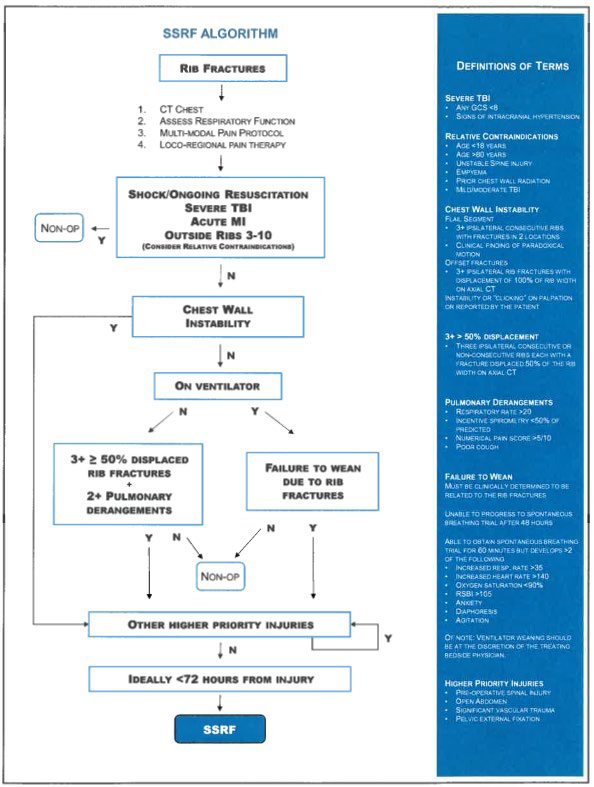
Surgical Stabilization of rib fractures should be considered in patients with flail chest, flail sternum, and painful rib fractures associated with movement that have been refractory to conventional pain management in order to improve morbidity and mortality.
Indications
- Non-ventilated patients:
-
- Chest wall instability
-
- 3 or more segmental rib fractures (flail chest)
- 3 or more bi-cortically displaced/offset rib fractures
- clinical findings of paradoxical motion
- instability or "clicking" on palpation of chest wall or as reported by the patient
-
- 3 or more displaced rib fractures
-
- with displacement of >50% the rib width AND 2 or more pulmonary physiological derangements.
-
- Chest wall instability
-
- Ventilated patients:
-
- Chest wall instability
-
- 3 or more segmental rib fractures (flail chest)
- 3 or more bi-cortically displaced/offset rib fractures
- clinical findings of paradoxical motion
- instability or "clicking" on palpation of chest wall or as reported by the patient
-
- Failure to wean from ventilator
- Chest wall instability
-
Contraindications
- Absolute
-
- shock/ongoing resuscitation
- severe traumatic brain injury
- acute myocardial infarction
- fractures outside of ribs 3-10
-
- Relative
-
- Age <18 yrs
- Age >80 yrs
- unstable spine injury
- empyema
- history of chest wall radiation
- mild to moderate traumatic brain injury
-
Timing
- Non-ventilated patients
-
- when feasible, less than 24 hrs is optimal
- should be performed within 72 hours of injury
- SSRF should be delayed in the face of higher priority injuries
-
- Ventilated patients
-
- earliest feasible time for flail indication
- should be performed within 72 hrs of injury for non-flail indications.
- SSRF should be delayed in the face of higher priority injuries.
-
References
Author(s)
Zachary Bauman, DO
Last Updated
May, 2020