
Adult ICU Electrolyte Replacement
Purpose
To define patients eligible for the electrolyte replacement protocol; to define the process for a provider to order the electrolyte replacement protocol; for a nurse to order and administer electrolyte replacement using this protocol; for a pharmacist to ensure safe dosing of electrolyte replacement; and for when the provider should be contacted when a patient has the electrolyte replacement protocol order set placed.
Policy
Standardized electrolyte replacement will be available for eligible adult ICU patient using an interdisciplinary approach. This includes but is not limited to medication management and monitoring.
Exclusion criteria are as follows:
- Pediatric patients (less than 19 yrs of age)
- Weight < 40 kg
- Renal dysfunction (serum creatinine 1.5 mg/dL or greater or increase in serum creatinine by 50% or renal replacement therapy) within the past 3 days
- pH <7.2 or pH >7.5 within the past 24 hours
- Diabetic ketoacidosis
Procedure
- The ICU Electrolyte Replacement Order Set will be initiated by the ordering provider. The provider will select which electrolytes (magnesium, potassium) they would like to have replaced via protocol, as well as the goal electrolyte level and preferred route of replacement.
-
- NOTE: if exclusion criteria has been met, the provider will be unable to place the order.
-
- The ICU Electrolyte Replacement Order Set will be continued perpetuity and should be evaluated daily to ensure appropriateness of continuation. If a patient develops exclusion criteria and the electrolyte protocol is still ordered, the nurse will be notified of the exclusion criteria that the patient has met and will be instructed to contact the provider regarding replacement.
- With the provider initiating and signing the ICU Electrolyte Replacement order, this allows the nurse to enter appropriate replacement and laboratory monitoring orders.
- When entering subsequent orders the nurse will enter those orders using the appropriate provider name and "Per protocol: cosign required".
Magnesium Replacement
-
-
- The ICU Magnesium Replacement Order Set will be initiated by the ordering provider. They will be required to select the preferred route of replacement (enteral/parenteral or IV only) as well as the magnesium goal level.
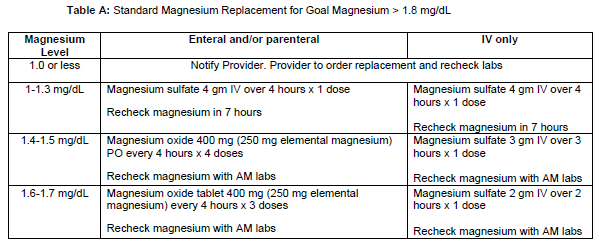
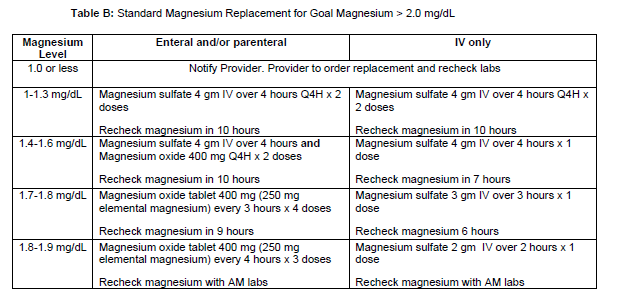
- With the provider initiating and signing the ICU Electrolyte Replacement Order Set, this allows the nurse to enter the appropriate replacement and laboratory monitoring orders per Table A or B.
- when entering subsequent orders, the nurse will enter those orders using the appropriate provider name and "Per protocol: cosign required".
- If the Magnesium Replacement Order Set is initiated and the patient has sub-therapeutic magnesium levels within the previous 3 hours, a task will be added to the nursing work list.
- To address the magnesium electrolyte replacement, the nurse will access the ICU Electrolyte Replacement Order Sets within the manage orders tab. The order set will be listed under suggestions. Upon opening the order set, appropriate replacement and lab orders will be presented to the nurse per Table A or B, to enter and sign.
- During verification, the pharmacist will confirm that the order is appropriate per Table A or B.
-
- Duplicate replacement orders will flag on the verification screen.
- "Off protocol" oral replacement will be allowed in certain instances (i.e., continuation of home scheduled magnesium regimen).
-
- After pharmacist verification and acknowledgement of the order, the nurse will administer the ordered dose orally or via the infusion pump.
- The following situations describe when the ordering provider or designee MUST be contracted:
-
- The patient meets exclusion criteria and is ineligible to receive ongoing electrolyte replacement via this protocol.
- The magnesium level is below threshold specified by Table A or B.
-
-
Potassium Replacement
-
-
- The Potassium Replacement Order Set will be initiated by the ordering provider. They will be required to select the preferred route (enteral/parenteral or IV only) as well as the potassium goal level.
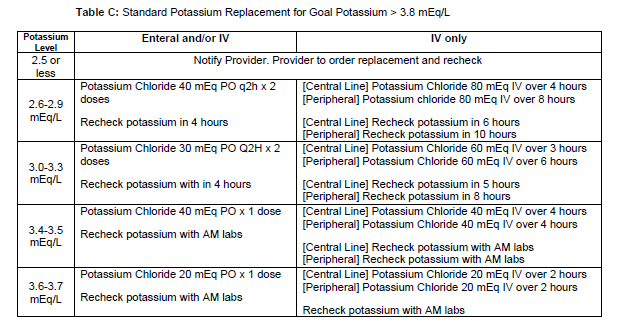
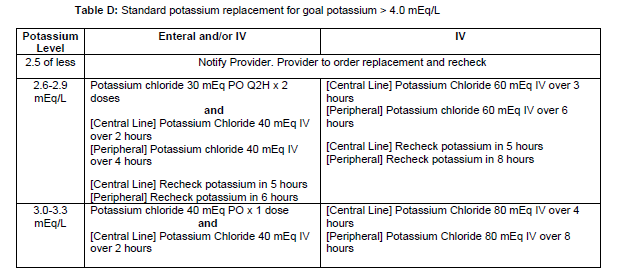
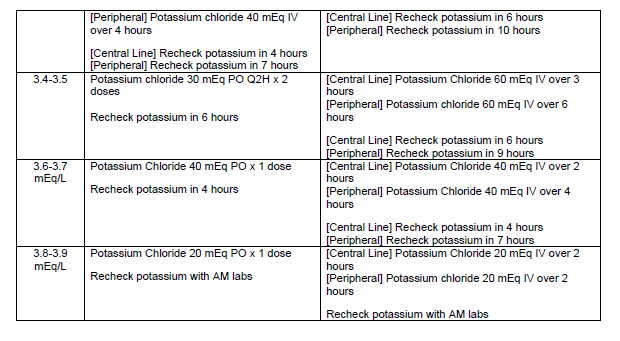
- With the provider initiated and signing the ICU Electrolyte Replacement Order Set, this allows the nurse to enter appropriate replacement and laboratory monitoring orders per Table C or D.
- When entering subsequent orders, the nurse will enter those orders using the appropriate provider name and "Per protocol: cosign required".
- If the Potassium Replacement Order Set is initiated and the patient has sub-therapeutic potassium levels within the previous 3 hours, a task will be added to the nursing work list.
- To address the potassium electrolyte replacement, the nurse will access the ICU Electrolyte Replacement Order Sets within the manage orders tab. The order set will be listed under suggestions. Upon opening the order set, appropriate replacement and lab orders will be presented to the nurse per Table C or D, to enter and sign.
-
- NOTE: if the RN has central line access, but is unable to administer using the central line due to concomitant infusions, they will contact the pharmacist to request a change in concentration.
- NOTE: if the RN has central line access, but is unable to administer using the central line due to concomitant infusions, they will contact the pharmacist to request a change in concentration.
-
- During verification the pharmacist will confirm that the order is appropriate per Table C or D.
-
- Duplicate replacement orders will flag on the verification screen.
- "Off protocol" oral replacement will be allowed in certain instances (i.e., continuation of home scheduled potassium regimen or intermittent loop diuretic doses).
-
- After pharmacist verification and acknowledgement of the order, the nurse will administer the ordered dose orally or via the infusion pump.
- The following situations describe when the ordering provider or designee MUST be contacted:
-
- The patient meets exclusion criteria and is ineligible to receive ongoing electrolyte replacement via this protocol.
- The potassium level is below threshold specified by Table C or D.
-
-
Authors
- Medication Management Committee (06/2022)
- P&T Formulary Committee (06/2022)
- Clinical Governance (07/2022)
Last Updated
7/2022