
Management of Open Fractures
Purpose
Open fractures are high energy injuries that have increased risk of infection due to potential exposure of bone and deep tissue to a variety of environmental debris. Infection can lead to serious complications including nonunion of wounds and osteomyelitis.
Definitions
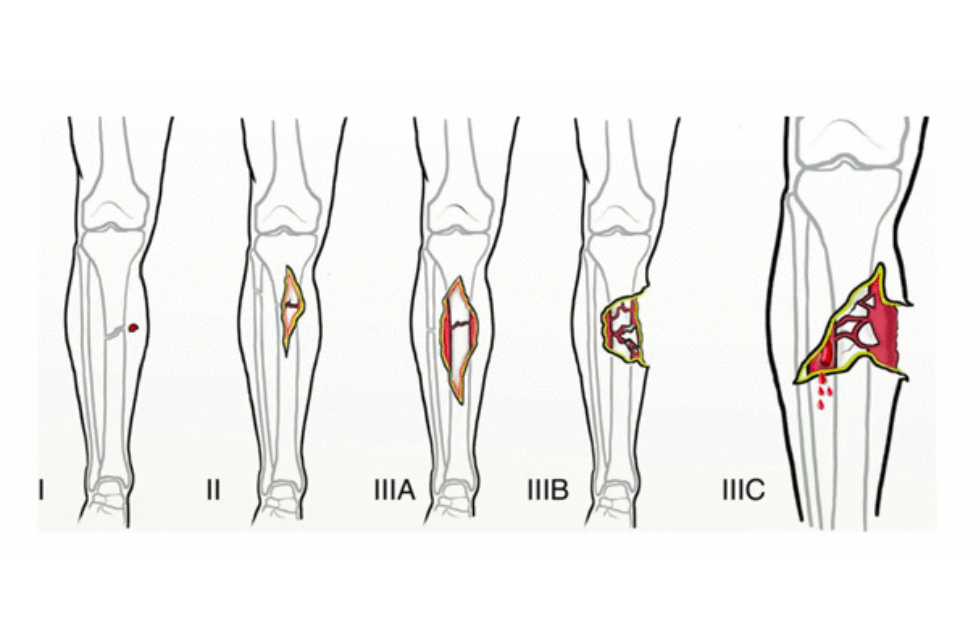
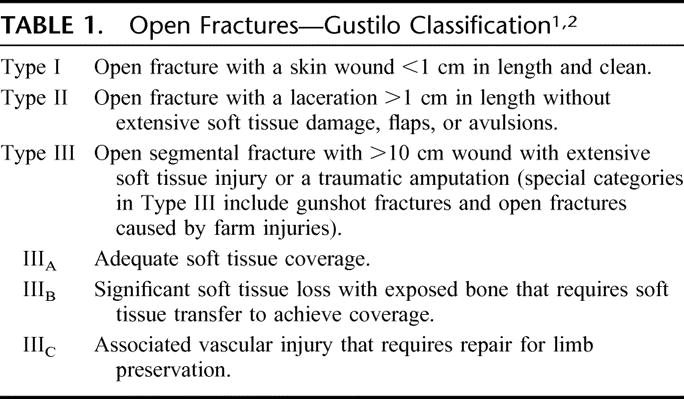
Gustilo-Anderson Classifications for open fractures
| Type I fracture |
open fracture with clean wound <1cm long |
| Type II fracture | open fracture with laceration >1cm long without extensive soft tissue damage |
| Type III (A-D) fracture | open segmental fracture, open fracture with extensive soft tissue damage, or traumatic amputation. |
Antibiotic Prophylaxis:
- Intravenous antibiotic prophylaxis should be given to patients with open fractures within 60 minutes of presentation to reduce the risk of infection.
- Antibiotic prophylaxis and duration is based upon the risk of infection utilizing the Gustilo-Anderson Classification System (listed above), with increasing rates of infection associated with higher grades.
- Please refer to: Antimicrobial Stewardship Program Open Fracture Prophylaxis Protocol on the Nebraska Medicine intranet (https://www.unmc.edu/intmed/divisions/id/asp/surgical-prophylaxis/index.html), or the EPIC order set entitled Antibiotic Prophylaxis for Open Fractures (304010005108) for specific antibiotics, dosing, and frequency.
Operative Treatment:
- Open fractures should be taken to the operating room on an urgent basis for irrigation and debridement within 24 hours of initial presentation or sooner whenever possible.
- When possible, skin defects overlying open fractures should be closed at the time of initial debridement.
Performance Improvement:
- All long bone open fractures will be monitored through the Trauma Performance Improvement Process. Specific indicators include:
-
- Time from arrival to first antibiotic dose.
- Time from arrival to initial irrigation and debridement.
-
References
- American College of Surgeons Trauma Quality Improvement Program. ACS TQIP Best Practices in the Management of Orthopedic Trauma. 2015. Retrieved from https://www.facs.org/~/media/files/quality-programs/trauma/tquip/ortho_guidelines.ashx.
- Anderson A, Miller AD, Bookstaver PB. Antimicrobial prophylaxis in open lower extremity fractures. Open Access Emergency Medicine. 2011;3:7-11. doi:10.2147/OAEM.S11862.
- Drunkel N, Pittet D, Tovmirzaeva L, Suva D, Bernard L, Lew D, Hoffmeyer P, Uckay I. Short duration of antibiotic prophylaxis in open fractures does not enhance risk of subsequent infection. The Bone and Joint Journal. 2013;95-B(6):831-837.
- Hauser CJ, Adams CA Jr., Eachempati SE. Surgical infection society guideline: Prophylactic antibiotic use in open fractures: An evidence-based guideline. Surgical Infections. 2006:74(4)379-405.
- Hoff WS, Bonadies JA, Cachecho R, Dorlac WC. EAST practice management guidelines work group: Update to practice management guidelines for prophylactic antibiotic use in open fractures. J Trauma Acute Care Surg. 2011;70(3):751-754.
- Rodriguez L, Jung HS, Goulet JA, Cicalo A, Machado-Aranda DA, Napalitano LM. Evidence-based protocol for prophylactic antibiotics in open fractures: Improved antibiotic stewardship with no increase in infection rates. J Trauma Acute Care Surg. 2014;77(3):400-408.
Author(s)
Justin Siebler, MD, Chief of Orthopedic Trauma
Last Updated
May, 2021